When you buy through links on our articles, Future and its syndication partners may earn a commission.

The first science results from a private spacecraft on the moon are challenging long-standing ideas about how our natural satellite evolved.
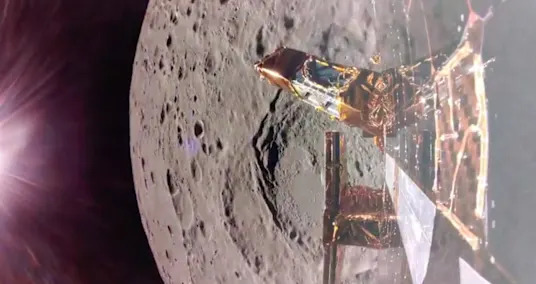
Researchers analyzing data from Firefly Aerospace's Blue Ghost lander, which landed on the moon in March 2025 and operated for about two weeks on the lunar surface, said the new measurements cast doubt on the decades-old view of the moon as divided between a hotter near side — the face visible from Earth — and cooler regions elsewhere.
"We need to take a second look at how we define the hot region on the moon," Seiichi Nagihara, a geophysicist at Texas Tech University and principal investigator of Blue Ghost's heat-flow probe, said at at the Lunar and Planetary Science Conference in Texas in March.
The prevailing idea stems in part from observations that most of the moon's lava flows are concentrated on the near side, forming the dark plains, or lunar maria, visible from Earth. Samples returned during the Apollo missions have linked this to higher concentrations of heat-producing radioactive elements such as thorium, whose decay likely fueled ancient volcanic eruptions, while much of the rest of the moon remained comparatively cooler.
The car-sized Blue Ghost deliberately targeted Mare Crisium — a volcanic plain "far outside" the traditionally defined heat-rich region — where the interior was expected to be cooler, Nagihara said.
Previous measurements of this kind, from NASA's Apollo 15 and Apollo 17 missions over 50 years ago, were taken at the edges of major impact basins — Mare Imbrium and Mare Serenitatis, respectively — both geologically complex regions.
"This time we wanted to go to a relatively simpler place," Nagihara said, "so we just landed in the middle of the Mare [Crisium]."

To estimate how much heat is escaping from the moon's interior at the landing site, scientists used one of the lander's 10 instruments, LISTER — a drill-based heat probe mounted on the underside of the spacecraft — to take measurements at incremental depths below the surface.
Before the mission, researchers had hoped LISTER would penetrate deeper than 1 meter into the subsurface, where temperatures are less affected by extreme day-night cycles. But as the instrument drilled using compressed nitrogen gas, it encountered dense, rocky soil that made excavation difficult, Nagihara said.
"It didn't go that well," he recalled. "We kept trying for a while, but it didn't make much progress."
LISTER ultimately drilled to a depth of close to 36 inches (98 centimeters) within 24 hours, taking eight measurements along the way. Those measurements show heat flow at the landing site was comparable to values recorded during NASA's Apollo 15 and Apollo 17 missions.

The result suggests that heat-producing elements such as thorium may be more widely distributed beneath the lunar surface than previously thought, researchers say.
One possible explanation is that volcanism may have been more active in some regions simply because the crust there is thinner, making it easier for magma to reach the surface, said Robert Grimm, a planetary geophysicist at the Southwest Research Institute during his March 17 presentation at the conference.
Grimm, who is the principal investigator of another instrument aboard Blue Ghost — the Lunar Magnetotelluric Sounder (LMS) — presented results from the device, which measured magnetic and electrical fields at the surface to infer temperatures inside the moon. Those findings suggest that heat-producing radioactive elements may be concentrated relatively close to the surface, within the crust, he said.
Scientists agree that more data will be needed to settle the debate. "We need more measurements," Nagihara said.
That evidence may soon be on the way, as a growing fleet of robotic missions are set to explore regions of the moon beyond the Apollo landing sites with instruments designed to probe its interior in greater detail.
The push comes as NASA ramps up efforts to return humans to the moon under its Artemis program, a multibillion-dollar initiative aimed at establishing a sustained presence on the lunar surface and building the infrastructure needed for future exploration through the end of the decade.
LATEST POSTS
- 1
 The Most Astonishing Arising Advances to Watch
 - 2Pick Your #1 game to observe
- 3Bring tissues and skip the mascara: The movie that's making theater-goers sob uncontrollaby
- 4Ukraine's new defense minister just outlined how dire its troop shortage has become
- 5The most effective method to Connect Successfully with Teachers in a Web based Setting



- The Reduced Portage Horse: An Inheritance Reconsidered for Present day Experience
- ‘It’s Israeli policy’: Report reveals abuse of Palestinians in prisons
- Watch live as near-Earth asteroid Eros buzzes the Andromeda Galaxy on Nov. 30 (video)
- 6 Nations for Setting up camp
- Cases of norovirus are on the rise just in time for the holiday season
- Empathy and reasoning aren’t rivals – new research shows they work together to drive people to help more
- Al-Sharaa denies he called for 80% of Syrians to return from Germany
- Wegovy maker Novo sharpens consumer focus with board role for Mars CEO
- Practice environmental safety in Style: Divulging Famous Electric Vehicle Brands