When you buy through links on our articles, Future and its syndication partners may earn a commission.

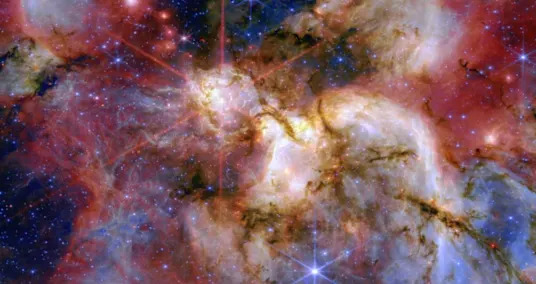
Astronomers have used the James Webb Space Telescope to study the star-forming region called W51, revealing "hidden" stars that were invisible to other telescopes.
The investigation has resulted in some absolutely stunning images that show the lanes of gas and dust illuminated by these young stars in unprecedented detail.
The team behind these observations was able to use the $10 billion space telescope to determine that the stars in W51 began to form within the last million years. If this makes these stellar infants sound ancient, consider that our middle-aged star, the sun, is around 4.6 billion years old.
This is far from the first time that astronomers have captured images of W51, but the JWST observations reveal these young stars like never before.
That is because these still-growing stellar infants are shrouded in natal blankets of gas and dust that readily block and absorb light, preventing most telescopes from seeing them. But infrared light is able to slip through these clouds, and that is the type of electromagnetic radiation that the JWST uses to observe the cosmos.
"With optical and ground-based infrared telescopes, we can't see through the dust to see the young stars," team member and University of Florida researcher Adam Ginsburg said in a statement accompanying the images. "Now we can."

Aside from their considerable aesthetic value, the images are of great scientific interest too. They could help researchers determine how massive stars like those that populate W51 form. The formation mechanism of high-mass stars is much less well understood than that of low-mass stellar bodies.
"Because of James Webb, we can see those hidden, young massive stars forming in this star-forming region," team member Taehwa Yoo of the University of Florida said. "By looking at them, we can study their formation mechanisms."

With the massive leap in quality of the JWST, the team was able to discover hitherto unseen structures in W51. This included shockwaves rippling out from infant stars, giant bubbles of gas, and dark filaments of dust.

"They are not the first photos of this region, but they are the best. They're so much better that they essentially are brand new photos," Ginsburg said. "Every time we look at these images, we learn something new and unexpected."
LATEST POSTS
- 1
 Which restaurants and fast food chains will be open on Christmas Eve and Christmas Day?
 - 2Scientists captured female sperm whales on video working together during a birth to protect the calf
- 3The Best 15 Applications for Efficiency and Association
- 4Nikki Glaser returns as host of the 2026 Golden Globes: Everything the comedian has said about the upcoming awards show
- 5Spain’s Picos de Europa: What to see and do in ‘the world’s most beautiful place’




- CVS forecasts 2026 profit above estimates on strong performance
- Ferrari Cavalcade Suspended After High-Speed Crash in Argentina Involving a Purosangue
- WATCH: IDF strikes, dismantles missile launchers in southern Lebanon
- Chemical leak in Oklahoma forces evacuations and leaves many ill
- Defense Minister Katz finally condemns Jewish extremist violence against Palestinians
- The Best Business visionaries Under 30
- Radiated Tortoise Faces Rapid Decline in Madagascar
- Higher cost, worse coverage: Affordable Care Act enrollees say expiring subsidies will hit them hard
- Vote In favor of Your Favored Comupter Game