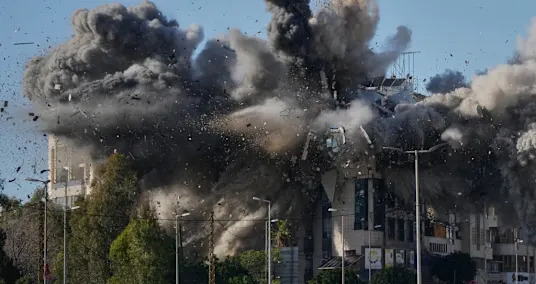
The US-Israel war on Iran and its ripple effect throughout the Middle East have had a devastating impact on Arab countries, with millions expected to slide into poverty, according to the United Nations.
A UN Development Programme (UNDP) report published on Tuesday said that gross domestic product (GDP) in the region was estimated to decline by approximately 3.7 to 6 percent after a month of war, equivalent to a contraction of $120bn to $194bn.
Abdallah Al Dardari, UN assistant secretary-general and director of the UNDP Regional Bureau for Arab States, said that 3.7 million jobs will be lost and about four million more people in the region could fall below the poverty line, noting that the war had highlighted the “fragility in the Arab economy”.
The report was based on projections of “a short but intense conflict lasting for four weeks”, signalling that the impact of the war, which has seen Iran attacking Gulf energy infrastructure and squeezing oil and gas exports through the Strait of Hormuz, will likely be even higher if it drags on longer.
Issued as tight oil supplies pushed Brent crude futures up 4.7 percent to more than $118 per barrel, the report said, “risks in strategic maritime corridors” had “knock‐on effects on inflation, trade flows, and global supply chains” that could undermine livelihoods in the Middle East’s “interconnected economies”.
It added that increases in poverty rates were “concentrated in the Levant and fragile countries (Sudan and Yemen), where baseline vulnerability is highest and shocks translate more strongly into welfare losses”.
The report noted that Lebanon, dragged into the war after Hezbollah struck Israel in retaliation for the US-Israeli killing of Iran’s Supreme Leader Ayatollah Ali Khamenei on February 28, is especially impacted, with “ongoing air strikes and evacuation orders … already causing widespread destruction of residential areas, transport infrastructure, and public services, alongside large‐scale displacement”.
“We hope the fighting will stop tomorrow, as every day of delay has negative repercussions on the global economy,” said Al Dardari.
LATEST POSTS
- 1
 New Year's superstitions: Eating 12 grapes, avoiding laundry and other rituals that are said to bring good fortune
 - 2All the ways Marjorie Taylor Greene has shifted her approach lately — and why Trump is 'surprised at her'
- 3Find the Wonders of the Silk Street: Following the Antiquated Shipping lanes
- 4Pick Your Number one breakfast food
- 5Picking the Right Pot for Your Plants: An Aide for Plant Devotees


- Opening Monetary Information: Your Exhaustive Manual for Finding out about Individual budget
- Marvel's X-Men are joining the battle in 'Avengers: Doomsday': Watch the teaser
- Productive CRM Programming for Client Relationship The executives
- New findings suggest atmosphere could exist on exoplanet TOI-561b
- Artemis moon mission breaks record for distance from Earth
- Watch interstellar comet 3I/ATLAS make its closest approach to Earth in free livestream on Dec. 18
- Flight cancellations: Full list of 40 airports hit by FAA cuts amid government shutdown
- Born under fire: MDA delivers baby in Jerusalem minutes before rushing to shelter
- Europe could get 42 more days of summer by the year 2100 due to climate change